
Mongolia Bulgan
Cycle Mongolia’s vast steppe and mountains, discovering nomadic culture, Orkhon Valley and endless open horizons.

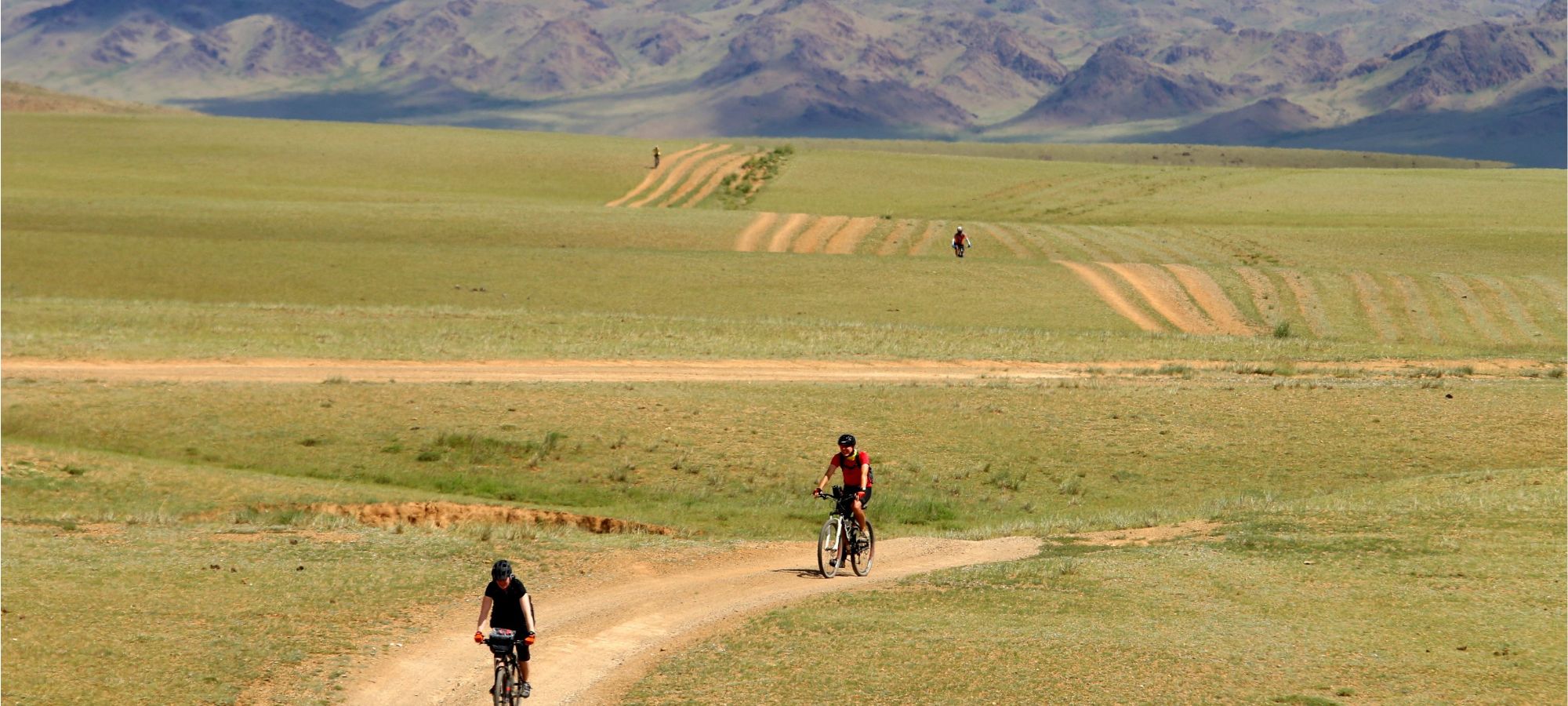
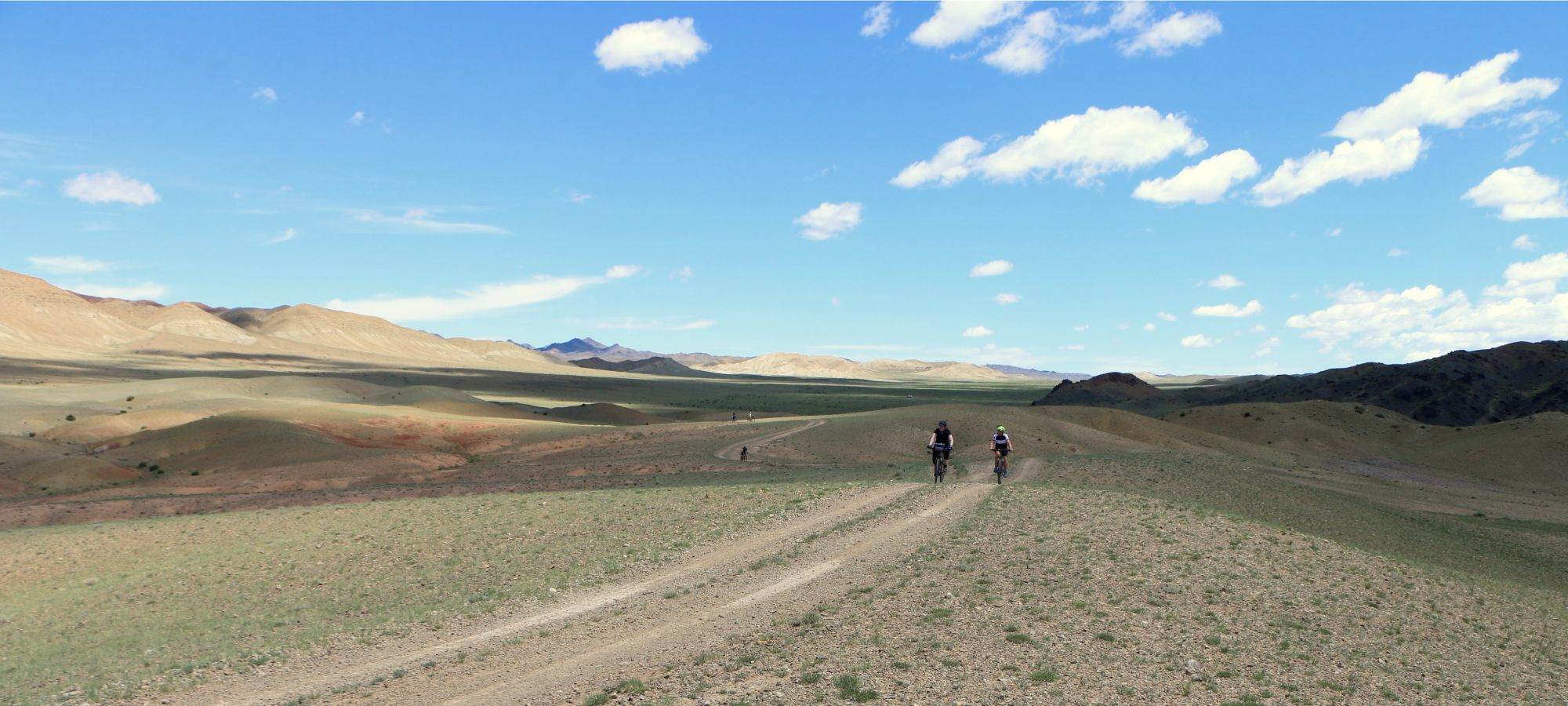
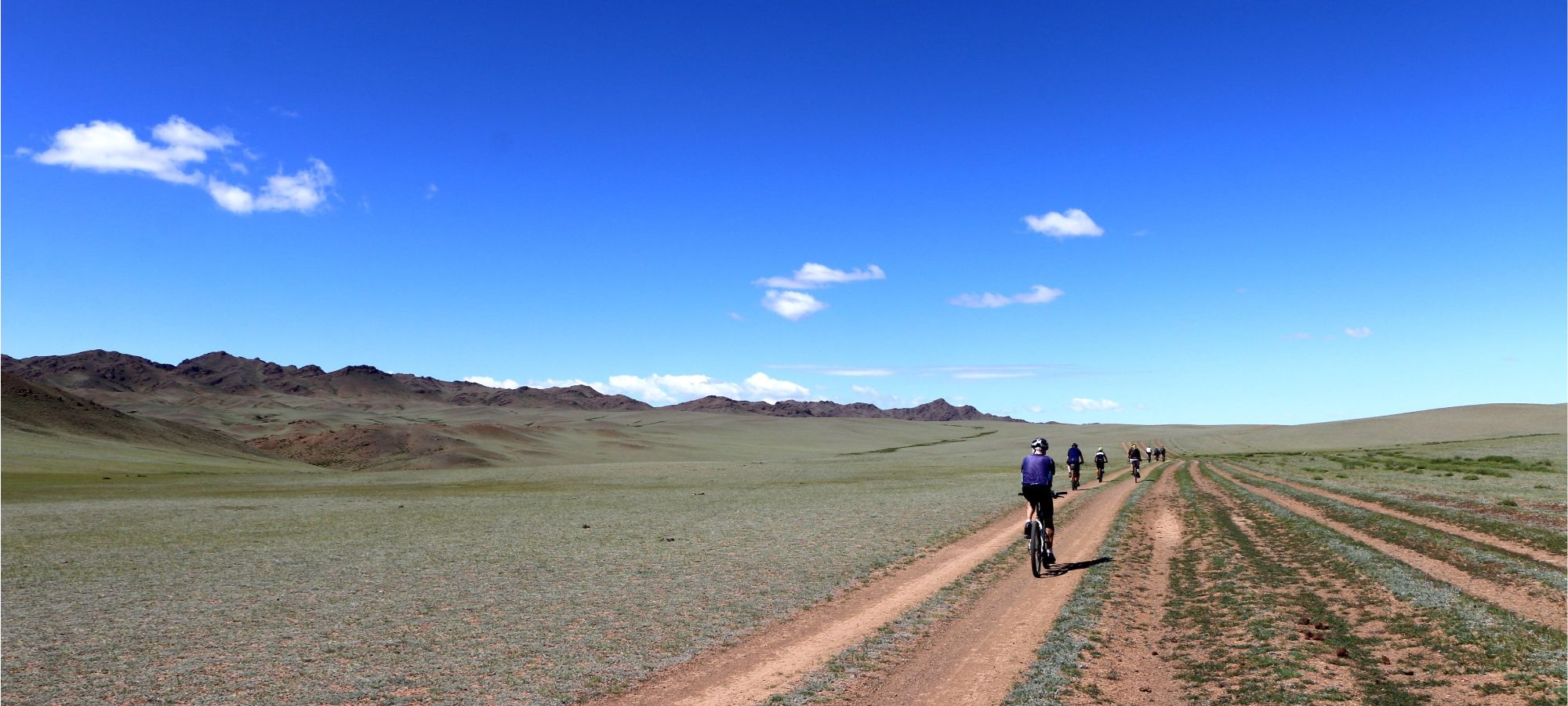
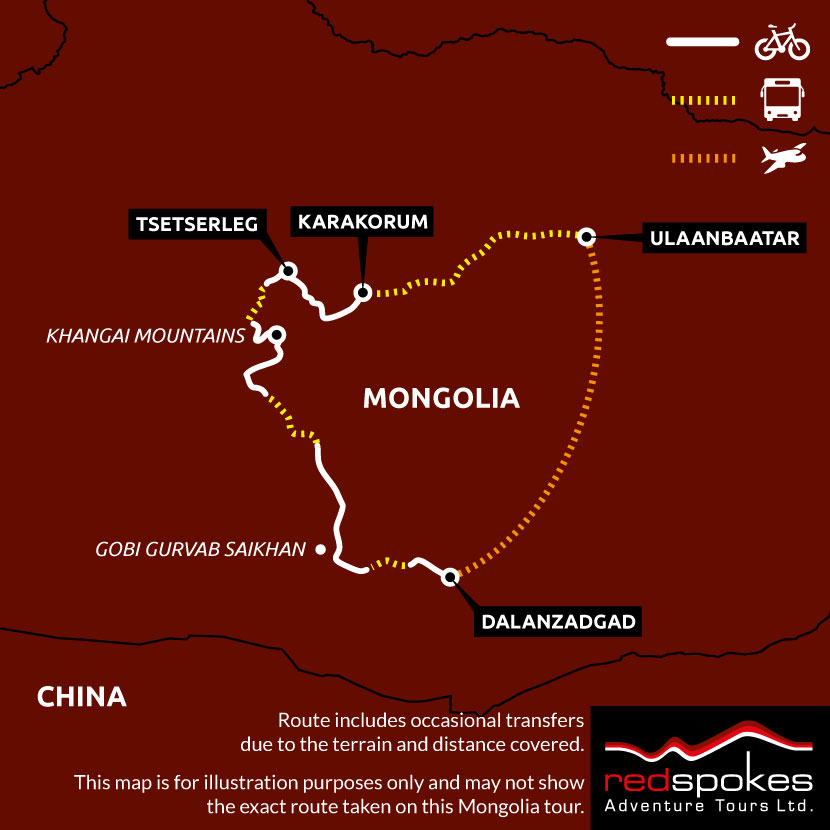
The redspokes Gobi Desert to the Khangai Mountains cycling holiday is a demanding off-road adventure through Mongolia’s vast and dramatic wilderness. Beginning in Ulaanbaatar, the journey heads south into the Gobi Desert, riding sandy tracks and wide-open plains to the Flaming Red Cliffs and the towering Khongoriin Els ‘Singing’ Sand Dunes. Encounters are few, often limited to nomadic herders and their livestock beneath endless skies.
From the desert, the route climbs into the Arts Bogd and Khangai mountain ranges, crossing remote passes, river valleys and volcanic landscapes marked by ancient petroglyphs. After soaking in the hot springs at Tsenkher, the adventure concludes at historic Karakorum before returning to Ulaanbaatar. This is true expedition-style cycling through one of the world’s last great frontiers.
Karakorum was one of the most important cities in the history of the Silk Road. Founded by Genghis Khan in 1220, Karakorum’s development as the capital of the Mongol Empire occurred in the 1230s under the direction of his son Ögedei. The Mongols had a profound impact on the history of trade across Central Asia. Their empire connected east and west, and opportunities for trade and exchange thrived during an era of peace and relative stability across territories under Mongol rule.
Karakorum is located on the most important east-west route across Mongolia, near the Orkhon River. This river valley was regarded as a sacred homeland by steppe peoples who traditionally based their capitals there. The Mongols would have been aware of the eary history of the region and built on its legacy.
Modern day Karakorum ‘Kharkhorin’ is a typical Soviet era town. Little remains of its historic past but the 16th C monastery Erdene Zuu Khild and the town’s fascinating museum attract visitors in great numbers. Within the museum you’ll find artefacts dating from the 13th and 14th century, pottery, bronzes, coins, religious statues and stone inscriptions. Orkhon valley provides the city with a beautiful setting.
The Khangai or Hangyyn Range is the largest of four mountain ranges in Mongolia. Khangai describes the forested steppe area to the north of the Gobi Desert. Located in central and northern Mongolia, it extends from north west to south east for 500 miles, it’s highest mountain Otgontenger rises to around 4000m. The intermediary steppe area is called Kheer or Tal. In Mongolian the word Khangai has associations with being a regal and gracious provider. The ancient name honours the sanctity of the mountain and its significance to those who depend on it. In between the rugged and remote expanses are picturesque lakes and ger camps where visitors are welcomed.
Some of Mongolia’s largest rivers spring from this region, including the Selenge, Orkhon, Zavkhan and Delgermoron.
The word Khairkhan (loving King) refers to sacred mountains. It is forbidden to refer to a mountain by name if it is in view, it should be called Khairkhan.
Mongolia’s Gobi Desert is the largest desert in Asia and fith largest desert in the world. It is often imagined as a lifeless wilderness, as in many other parts of the world. In reality, large areas of the Gobi are steppe and mountains; only 5% of the area is sand dunes although the desert areas are growing and grasslands diminishing as a result of climate change. Unusually for an area of desert, the region experiences snowfall in winter.
The Gobi is rich with wildlife including bears, camels, golden eagles, gazelles, kulan and even snow leopards. Of archaeological significance, the Mongolian Gobi is also the largest dinosaur fossil reservoir in the world, especially rich in specimens from the late Cretaceous period. The area experiences extreme changes of conditions both daily and seasonally. It is rich in mineral reserves such as copper, gold and coal deposits.
The Gobi Desert has its own mythical creature: olgoi-kharkhoi or the Mongolian Death Worm. The Death Worm is said to be a rare creature living deep in the sands of the Gobi. Those who claim to have seen it describe it as a dark red, three-foot-long fat worm with spikes sticking out of both of its ends. The worm can spit corrosive acidic venom and discharge a lethal electrical shock from a great distance. There is no evidence it actually exists, but it makes for a great talking point.
The development of mining in mineral rich areas surrounding Mongolia’s capital have seen the city develop over the last 15 years from quiet traditional principal city to a region buzzing with development and diversity. A literal gold rush. As well as industrial and commercial areas there are Ger districts on the outskirts of the city, where up to 800,000 nomads live in traditional tents.
Gandantegchinlen Monastery is Mongolia’s principal Buddhist temple. A gigantic gold-plated Buddha statue is the main object of devotion. Local worshippers dressed in traditional brightly coloured garments throng to the temple. The Tibetan Buddhist tradition, which spread to Mongolia in the 16th Century through the influence of the third Dalai Lama (Mongols gave him the title “Dalai,” a term which is now applied also to his predecessors.) The fourth Dalai Lama was a Mongol, and since the 17th century Mongolia has had its own equivalent to the Dalai Lama: Jebtsundamba Khutuktu. Gandantegchinlen Monastery was spared destruction by Soviet-backed regimes during religious-cultural purges. Since independence, renovating the Gandantegchilin has been a priority for the state.
Sükhbaatar Square named after Mongolia’s revolutionary hero Damdin Sükhbaatar shortly after his death in 1923. In 2013 the square’s name was changed to Chinggis Square in honor of Genghis Khan. Adjacent to the square, is the parliament building with a facade adorned by marble statues of Genghis Khan and his successors. The area throngs with newlyweds, reunification parties and the public in general, all eager for photo opportunities here for their celebrations.
The National Museum offers an overview of Mongolia’s history from stone age times to the modern era. Within the national museum is the Paleontology Museum of Mongolia containing artefacts such as dinosaur fossils such as intact nests containing eggs, carnivores fighting herbivores and embryos still in their shells.
A visit to the Zaisan memorial in the south of Ulaanbaatar offers panoramic views of the city. Climb 300 steps to reach the memorial which features a circular painting depicting scenes of friendship between the people of the USSR and Mongolia.
Zandraa Tumen-Ulzii. Tucked away on a side street on the eastern fringes of downtown Ulaanbaatar you will find the International Intellectual and Puzzle Museum. Mogolia has a history of puzzle-crafting and has created some of the world’s most difficult puzzles and chess sets. Shatar, a Mongolian version of chess, dates back to the Middle Ages. More modern burr puzzles (made from interlocking pieces of wood) can be traced back throughout the 1900s. Founded in 1990 as the nation’s first privately-owned museum by Tumen-Ulzii, a local toymaker, Zandraa Tumen-Ulzii is a shrine to games and magic from all over the world. The purpose of the museum is not just to catalogue the history of puzzles in Mongolia, but to remind visitors that curiosity and play are an important part of training the brain. Visitors to the museum are guided by a docent who performs magic tricks, watches you struggle with the puzzles and reveals their solutions to you in a matter of seconds.

redspokes’ Mongolia Gobi Desert to the Khangai Mountains cycling tour begins in capital city Ulaanbaatar (which translates as red hero). Nomadic, Buddhist, Soviet and contemporary influences converge in this vibrant capital where ancient culture and 21st Century traditions forge a unique path. You will be met on arrival at the airport and transferred to your joining hotel. The day is free to explore the city. This evening we will have a welcome dinner and group introductions. Your guide will give you a trip briefing.
Accommodation: Hotel
This morning we will take an internal flight to the Gobi Desert. Here we are joined by our local support team and our riding begins. We set off with a gentle 50km cycle across the Gobi plains to warm up for the more challenging days ahead. Early this evening we will have a vehicle transfer to the Bayanzag or ‘Flaming Red’ Cliffs. The red/orange sandstone rocks are named thus because they look as if they are on fire when the sun shines on them. In 1922, American palaeontologist, Roy Chapman Andrew, made the world’s first discovery of a nest of dinosaur eggs here and unearthed over 100 dinosaurs. We will spend some time exploring the area before a vehicle transfer back to our accommodation. Tonight, we stay in traditional Mongolian yurts, known as Ger camps.
Cycling distance: 48km (30miles)
Total Climb: 180m (590ft)
Total Descent: 92m (301ft)
Accommodation: Ger Camp (B,L,D)
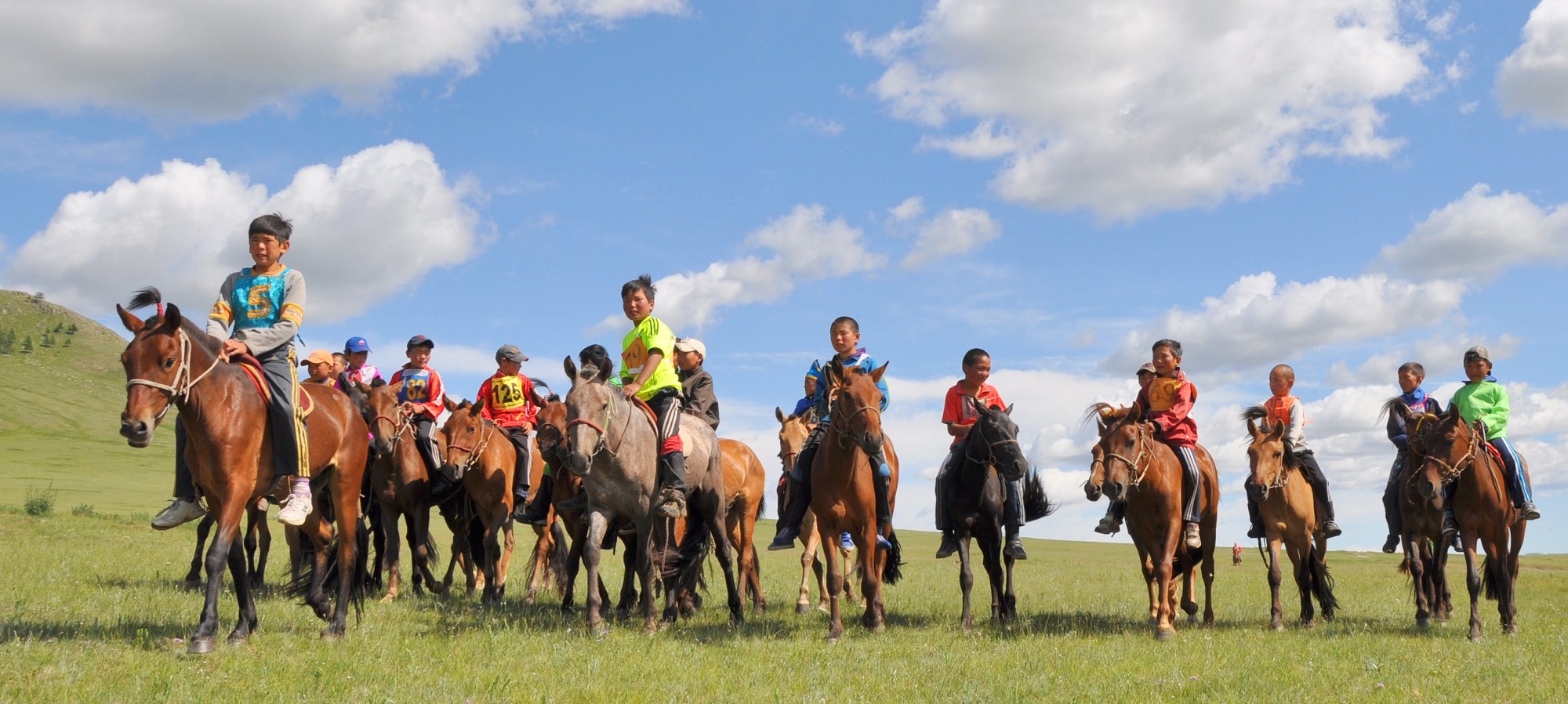
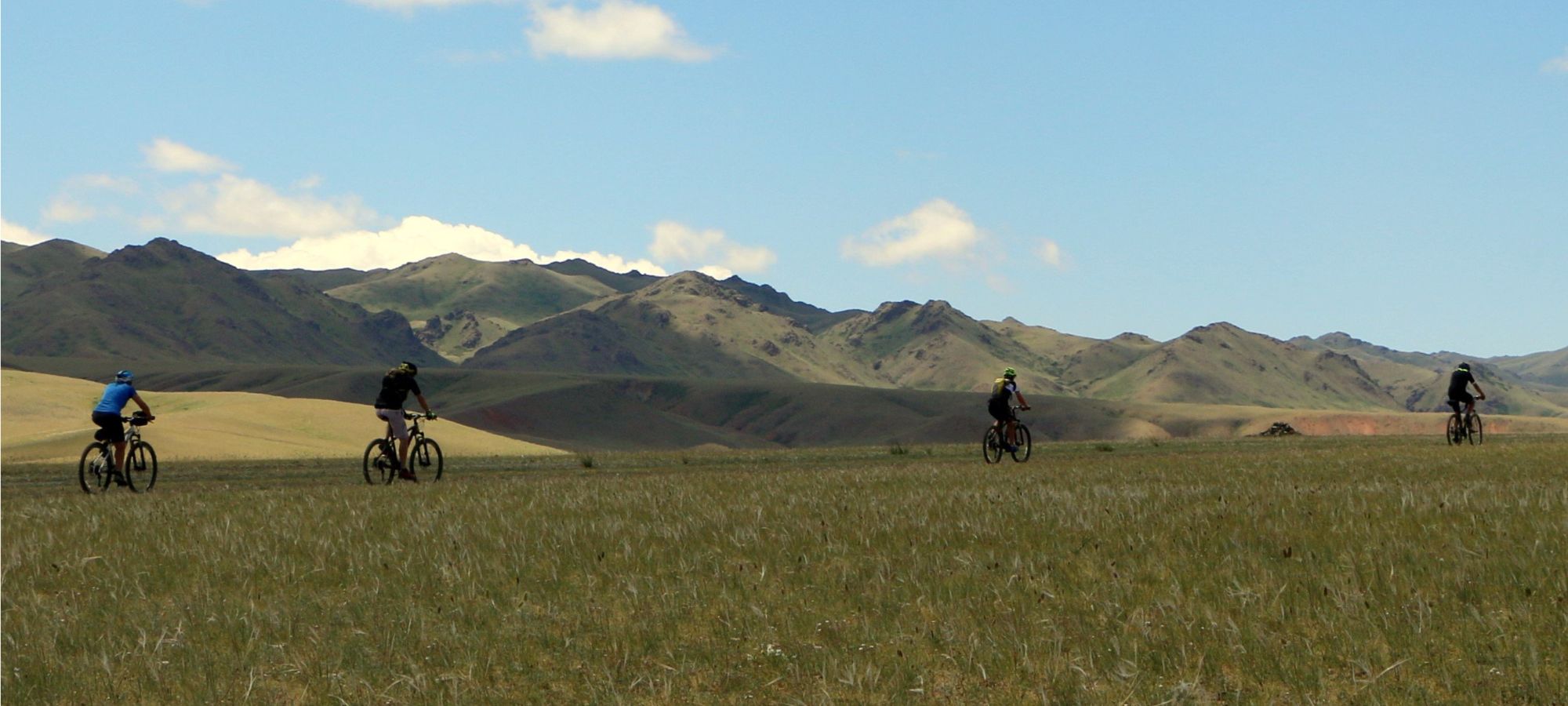
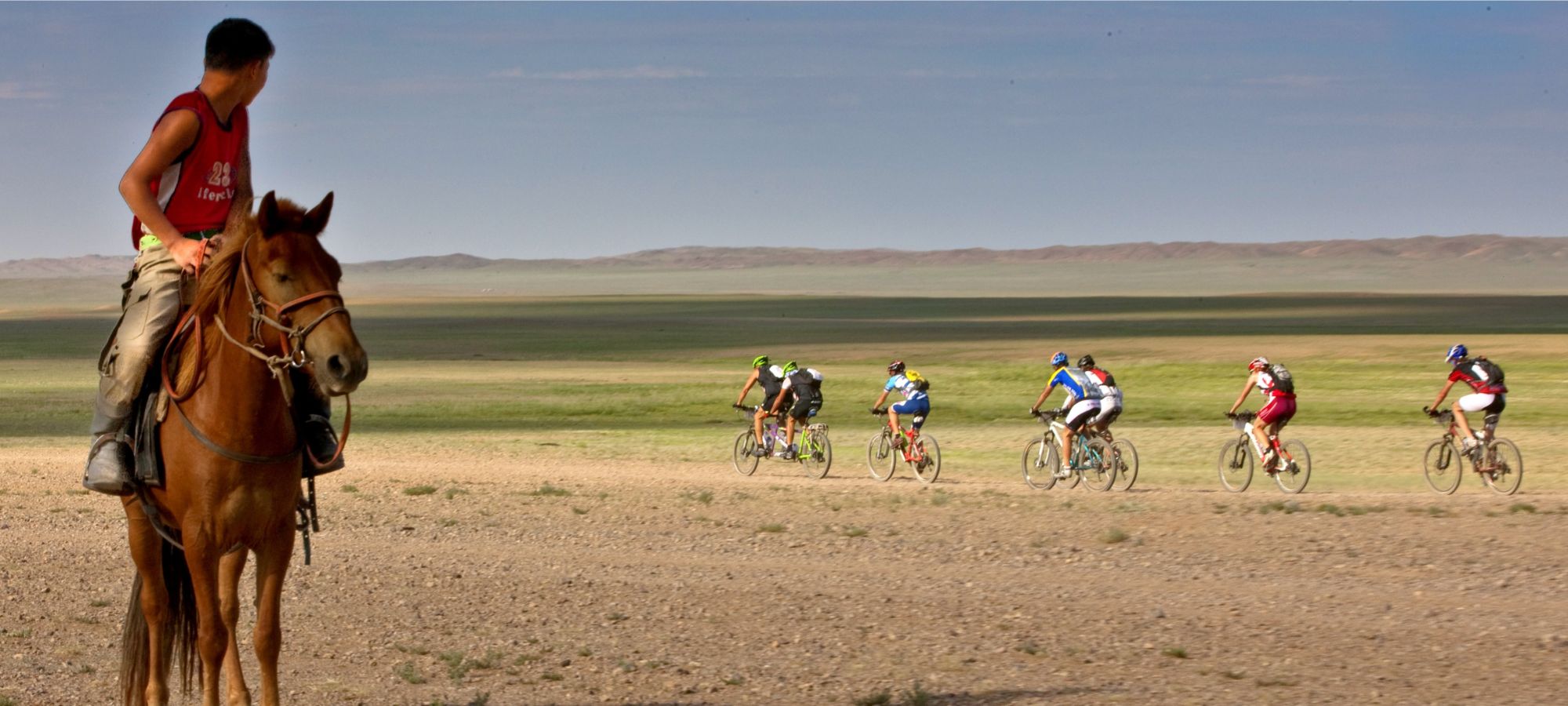
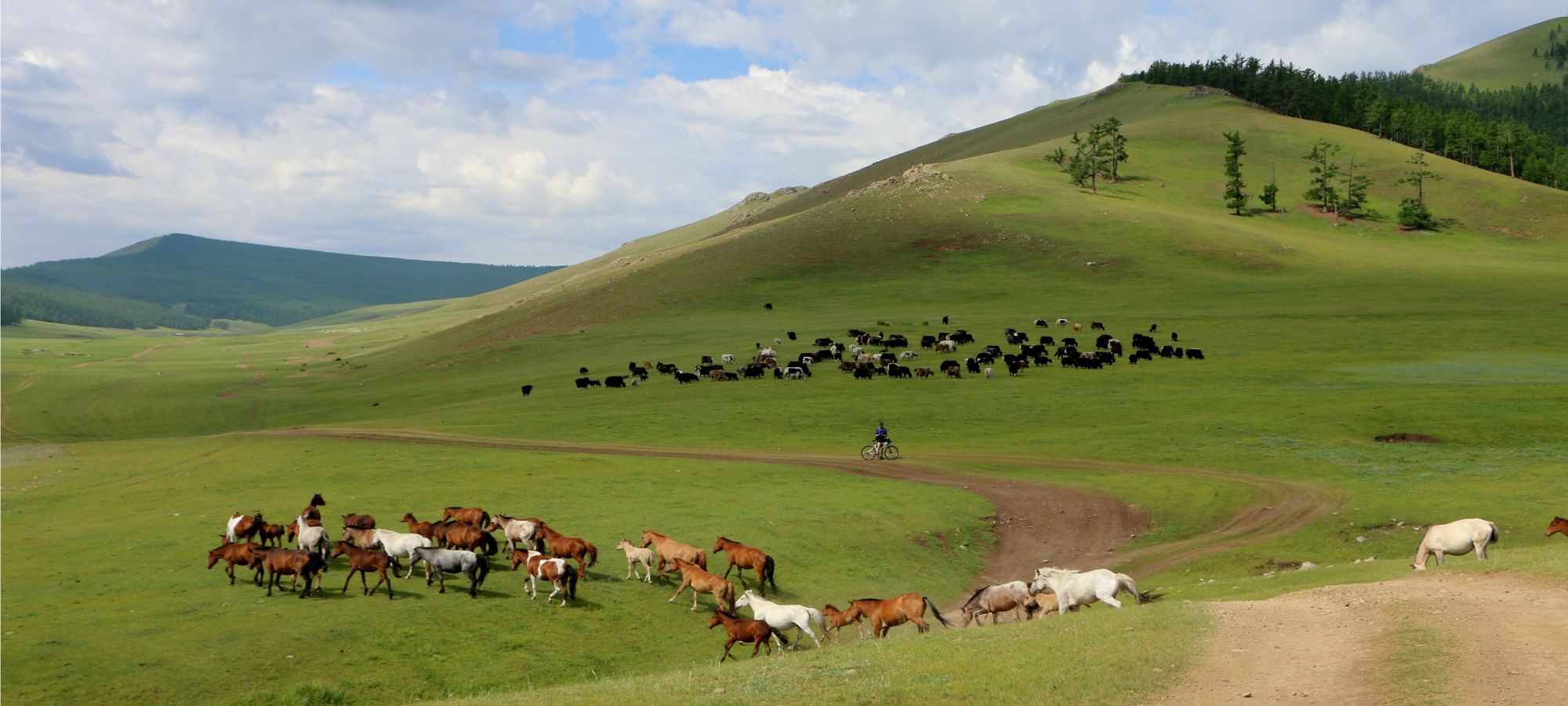
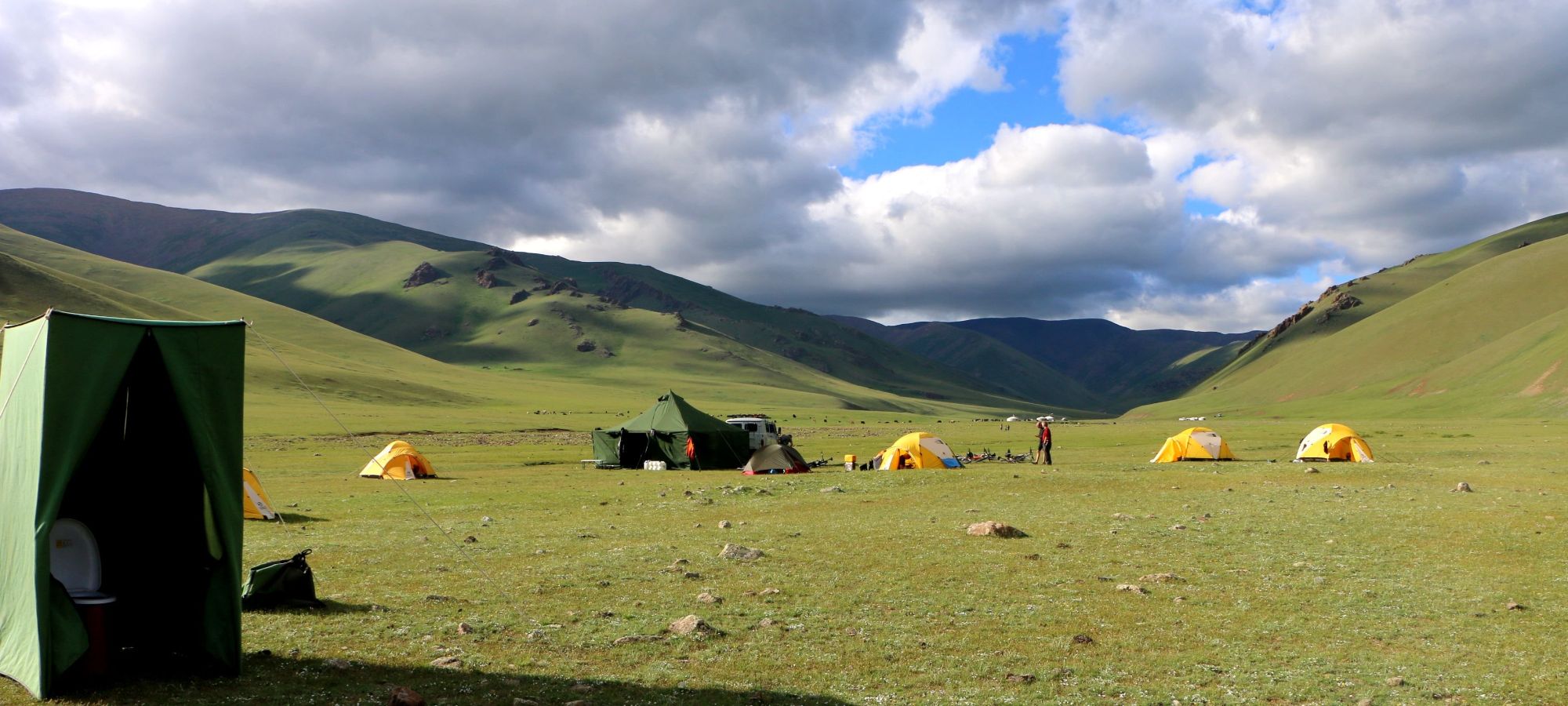
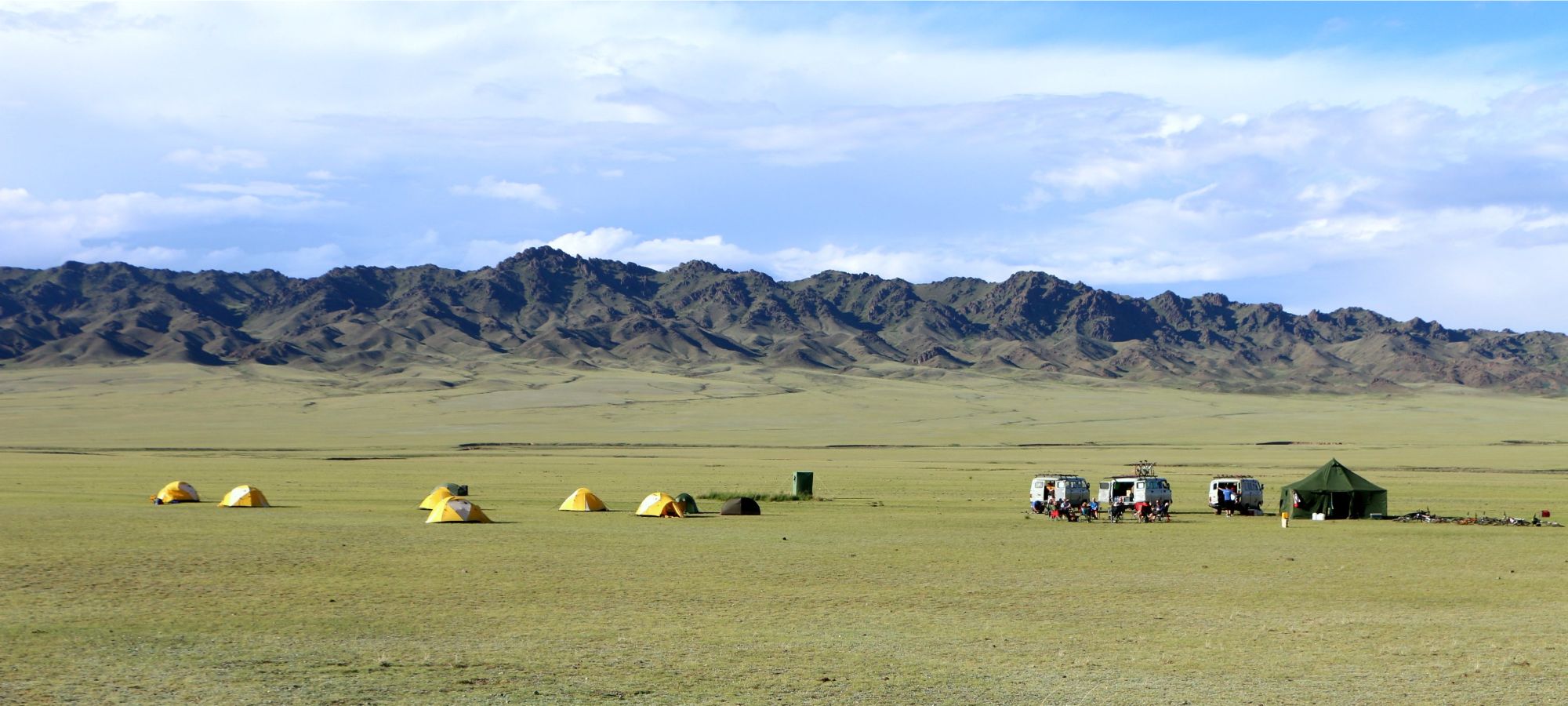
Today’s cycling is more challenging; we will be riding across the middle of the Gurvan Saikhan mountain range. We cycle an undulating terrain on the high plateau where local herders graze their flocks during the summertime; a tradition that has not changed in hundreds of years. We will pass herds of goats, flocks of sheep and horses with views of nomads’ yurts pitched on the wide plateau. Sheep outnumber humans in Mongolia 35 to 1 and horses 13 to 1. We ride mainly on well surfaced road with some sandy sections. Tonight, we pitch tents in a spectacular location surrounded by dramatic rock formations under a starlit sky.
Cycling distance: 69km (43miles)
Total Climb: 830m (2,723ft)
Total Descent: 290m (1115ft)
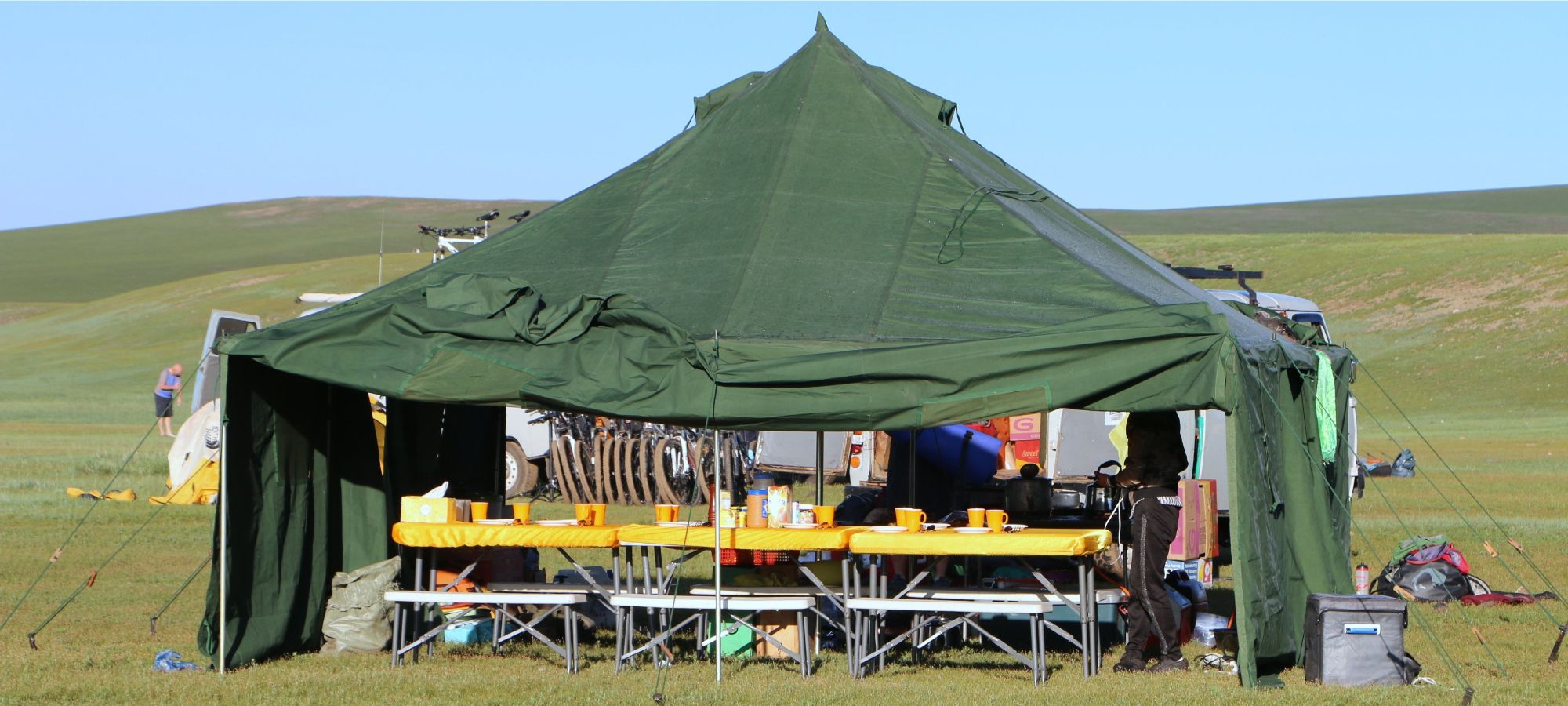
Accommodation: Camping (B,L,D)
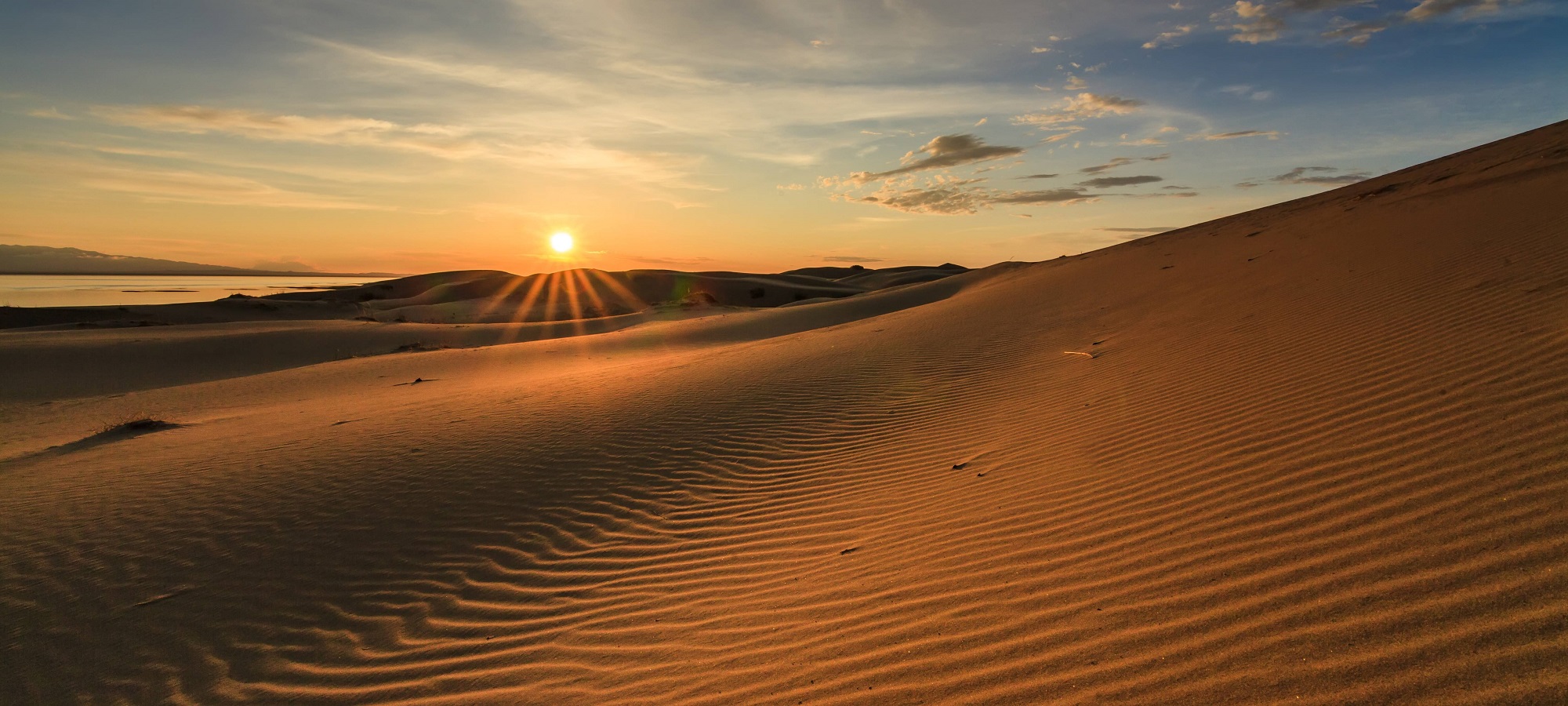
We begin the day following a dry river bed for 3km. From here on we ride a smooth surfaced road for the rest of the morning. Around midday we leave the Gurvan Saikhan mountain range behind us entering an open plain. In the distance we will see the Khongoryn Els Sand Dunes stretching over almost 100km. The tallest dune reaches a height of 200m. During windy days a humming sound can be heard emitting from the Khongoriin Els caused by collapsing crests – hence their name the Signing Sand Dunes. We will stop for a picnic lunch enjoying the dramatic scenery before we have a vehicle transfer of 50km (2 hours) to reach our ger camp for this evening.
Once the heat of the day has subsided, we will visit the Khongoriin Els and you will have the opportunity to take a camel ride along the dunes. Bactrian, two-humped camels are native to Mongolia; they are able to tolerate the extreme weather conditions of the Gobi from freezing cold to extreme heat. They can go without drinking water for as long as 2 months.
Cycling distance: 35km (21miles)
Total Climb: 210m (689ft)
Total Descent: 660m (2,165ft)
Accommodation:Ger Camp (B,L,D)
This morning we have another 45km (2 hours) vehicle transfer across the sands before our cycling begins. Once on the bikes we begin riding to the Arts Bogd mountain range that divides the Gobi Desert from the arid grasslands of central Mongolia. We will see the change in our surroundings as soon as we cross our high point of the day at 2,000m. Tonight we set up camp, pitching our tents near an extinct volcano. You will see ancient petroglyphs and burial mounds in the rock.
Cycling distance: 49km (30 miles)
Total Climb: 660m (2,165 ft)
Total Descent: 600m (1,968 ft)
Accommodation: Camping (B,L,D)
Today we transfer by vehicle travelling north west to the Khangai Mountain Range. During our 9 hour drive we will see the vast scope and variety of Mongolia and its landscapes as we travel away from dry grasslands to more humid mountain terrain. We reach the foothills of the Khangai Mountain Range early this evening and set up camp in a dry grassy valley.
Accommodation: Camping (B,L,D)
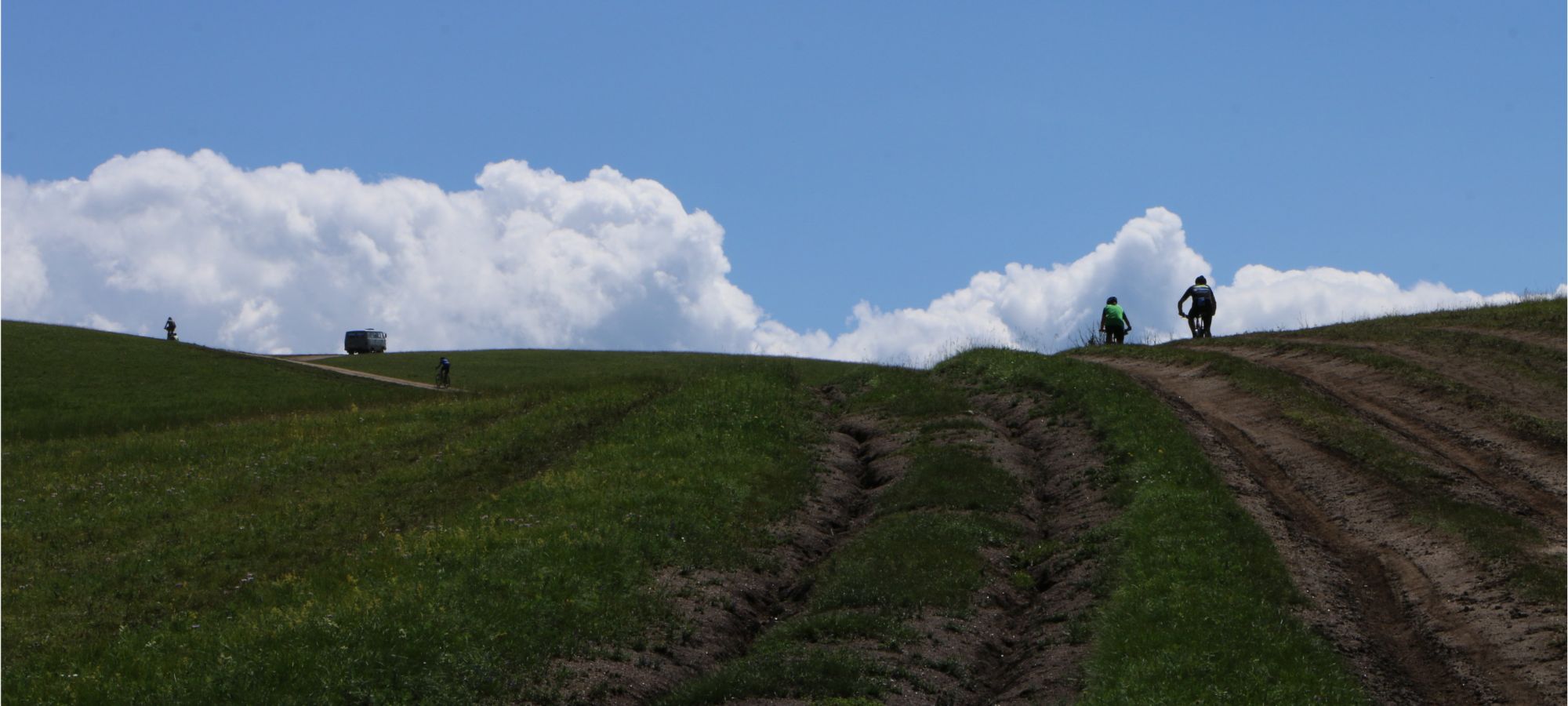
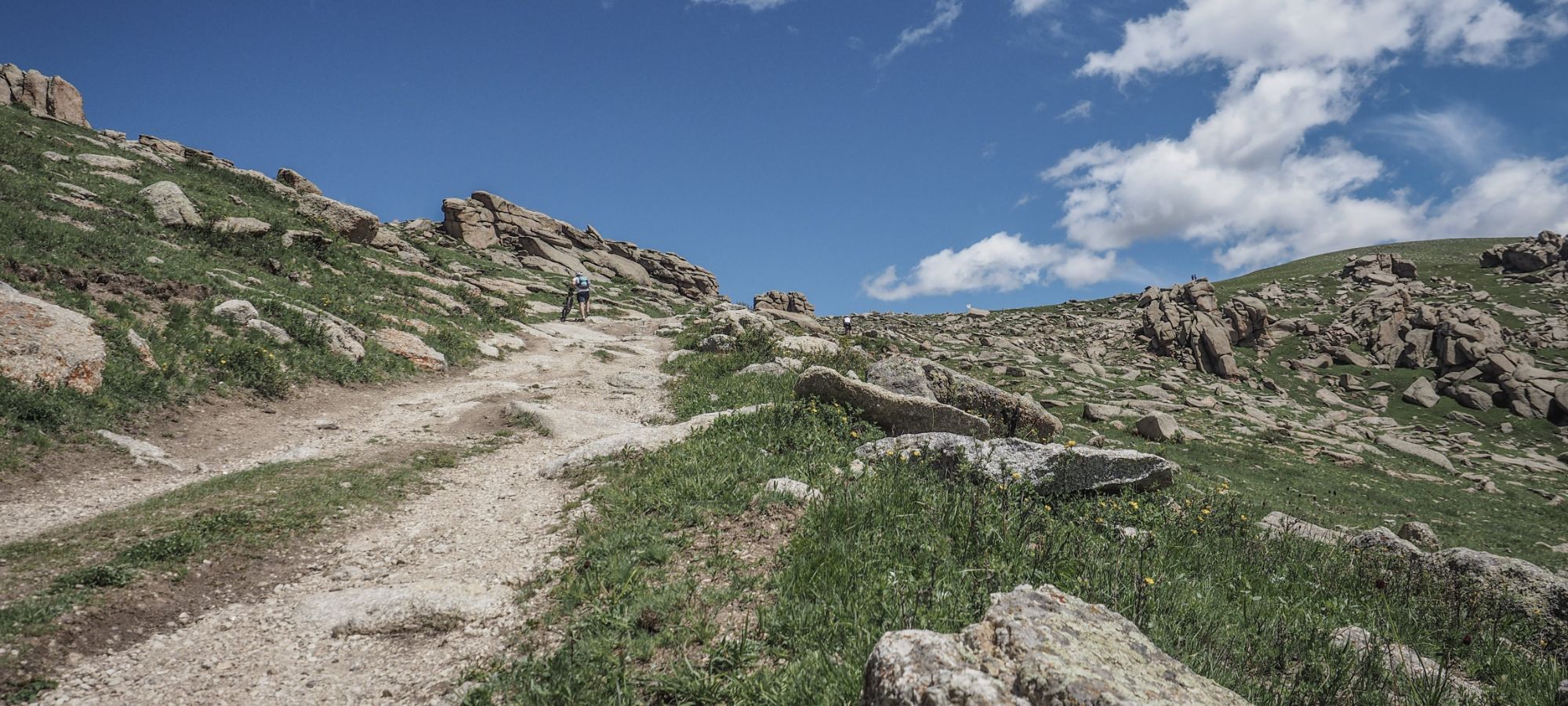
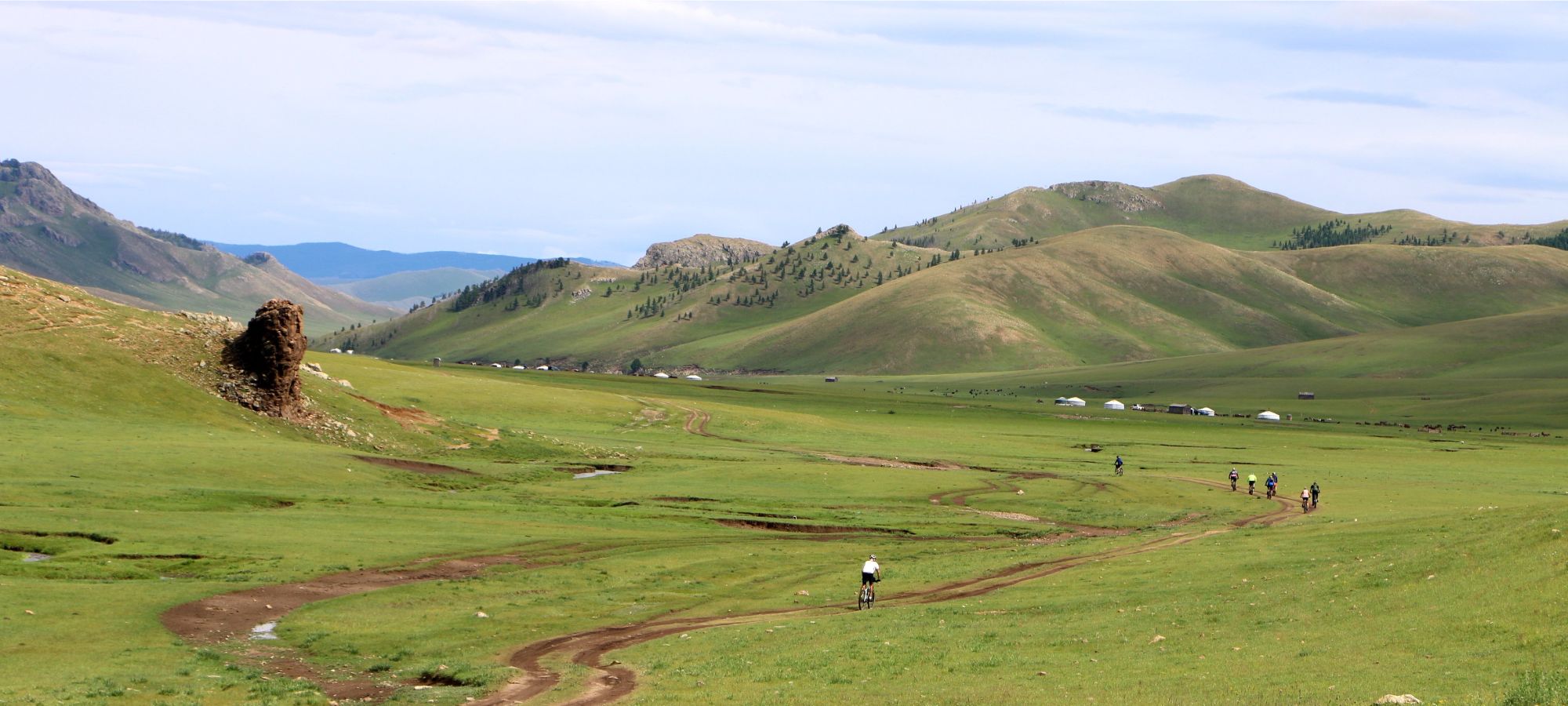
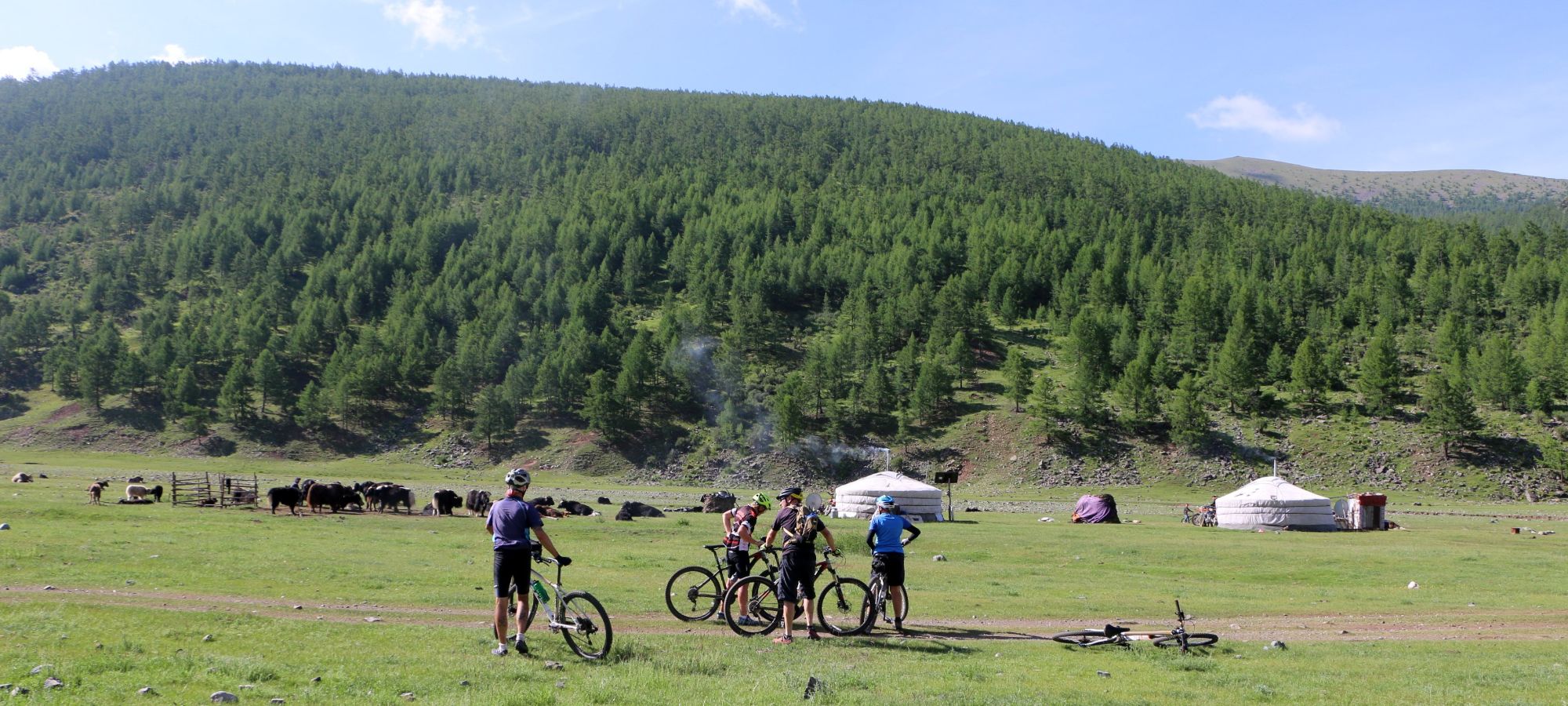
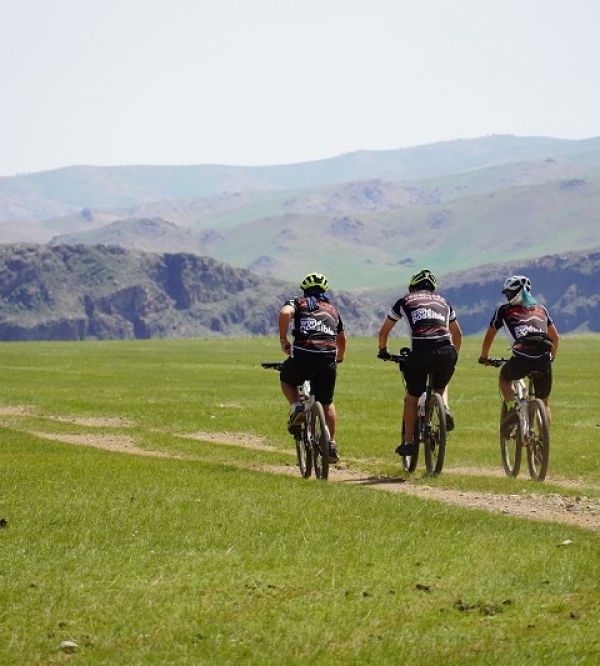
We gradually ascend throughout the day over a gentle incline. We will be riding on smooth gravel track across grassy hills all morning. We continue onto a surfaced mountainside road with dramatic views of the river valley beneath where you’ll see yak, horses, goats and sheep. There are rocky sections we have to contend with; your efforts will be rewarded by the beautiful surroundings. We reach the Shargaljuut mineral springs, some of which are boiling hot. The springs have been a source of therapeutic treatment to Mongolians for thousands of years. A soviet era spa resort is used today by Russian and Chinese visitors also, who come here to bathe in the mineral waters. After testing the waters we will ride on through the valley to a remote riverside location and set up camp near to local herders and their livestock.
Cycling distance: 55km (25 miles)
Total Climb: 885m (2,903ft)
Total Descent: 558m (1,830ft)
Accommodation: Camping (B,L,D)
This morning we continue cycling into the Khangai mountain range following a remote little-travelled route. For the next few days we will be riding a series of peaks each offering challenging uphill riding, dramatic viewpoints and thrilling downhill stretches. Local herders and their immense flocks will be your only companions as we journey through this spectacular unspoiled terrain. We camp tonight near the Khukh River.
Cycling distance: 40km (25 miles)
Total Climb: 855m (2,805 ft)
Total Descent: 558m (1,831) ft)
Accommodation: Camping (B,L,D)
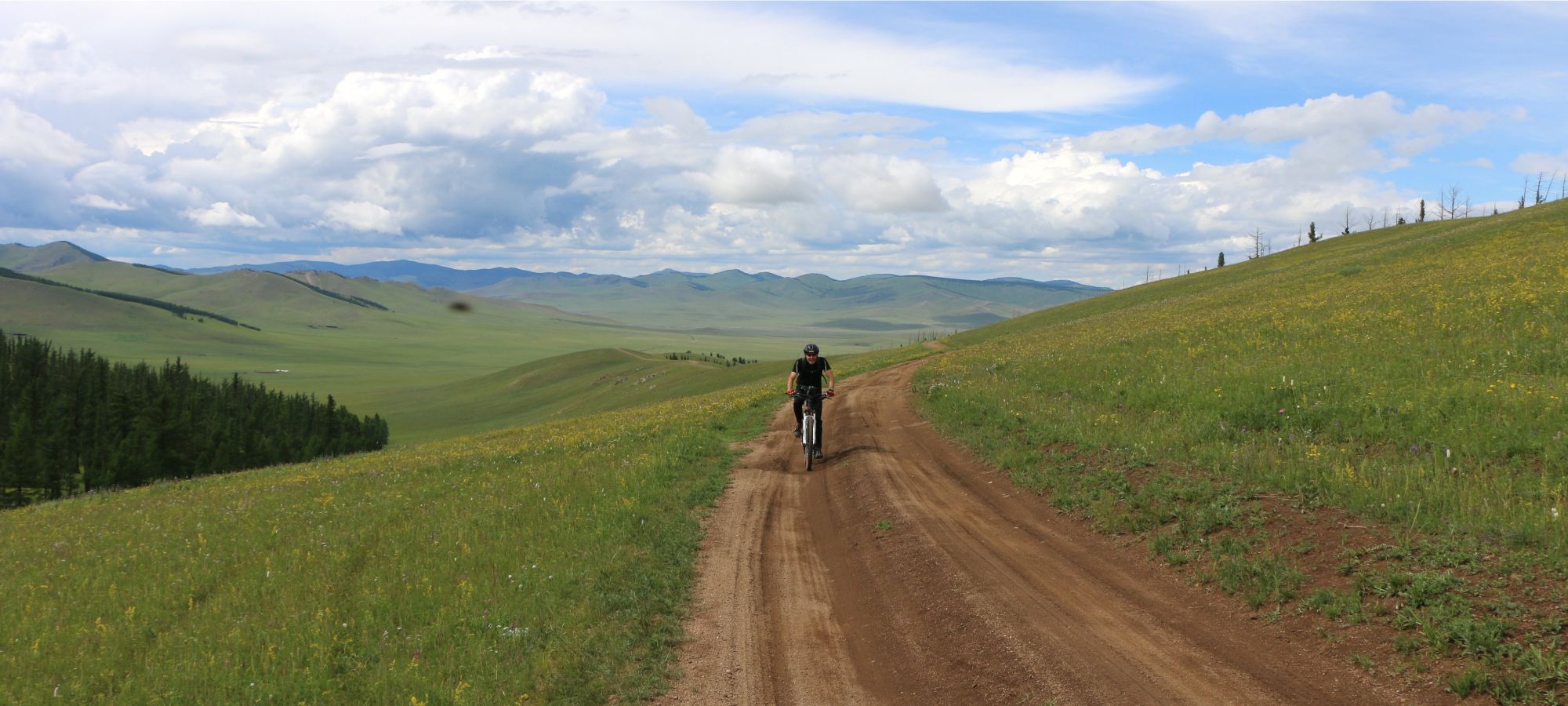
We begin cycling today with a 5km climb to our first pass we’ll be riding down over the peak for the next 5km before another short climb. We ride on making a gradual climb through our beautiful surroundings, passing local nomads and their herds to reach our high point of the day 2,832m. We end the day with a final downhill ride into the valley beneath.
Cycling distance: 42km (26 miles)
Total Climb: 739m (2,424 ft)
Total Descent: 803m (2,634 ft)
Accommodation: Camping (B,L,D)
This morning, we cycle for 25 km along the main river of the Khangai that flows south into the Gobi Desert to form a large saline lake. We will ride through some knee-deep streams. We then transfer 70 km (3 hours) by vehicle across the main water divide of the Khangai range passing along rocky, jolting track and dry riverbeds now filled with loose rock. Then we’re back on our bikes again to cycle the final 13 km of sweeping descent to reach our camp at an idyllic spot by the river.
Cycling distance: 38km (24 miles)
Total Climb: 143m (469 ft)
Total Descent: 324m (1,063 ft)
Accommodation: Camping (B,L,D)
Today we cycle from the north end of the Khangai range to Tsetserleg town. We begin with a short, steep pass continuing on well surfaced road for the rest of the day. as we approach Tsetserleg we have views of the brightly coloured roof tops of traditional houses laid out in a neat geometric pattern. This pretty provincial town is located in the shelter of a dramatic granite ridge. Tsetserleg means garden. There is time to visit the busy market where pine nuts, wild berries and other local products are on sale. Before we cycle on riding over three short but steep passes from the north side of the Khangai range to to visit the Tsenkher hot springs. Located in a lush wooded valley the area is renowned for its hot springs and a popular destination for both locals and tourists during the summer months. A soak in the mineral rich waters will be the perfect tonic for tired cyclists’ legs after our last few days of riding. We also have the opportunity this afternoon to use a laundry service.
Cycling distance: 91km (56 miles)
Total Climb: 994m (3,097 ft)
Total Descent: 1,215m (3,986 ft)
Accommodation: Ger Camp (B,L,D)
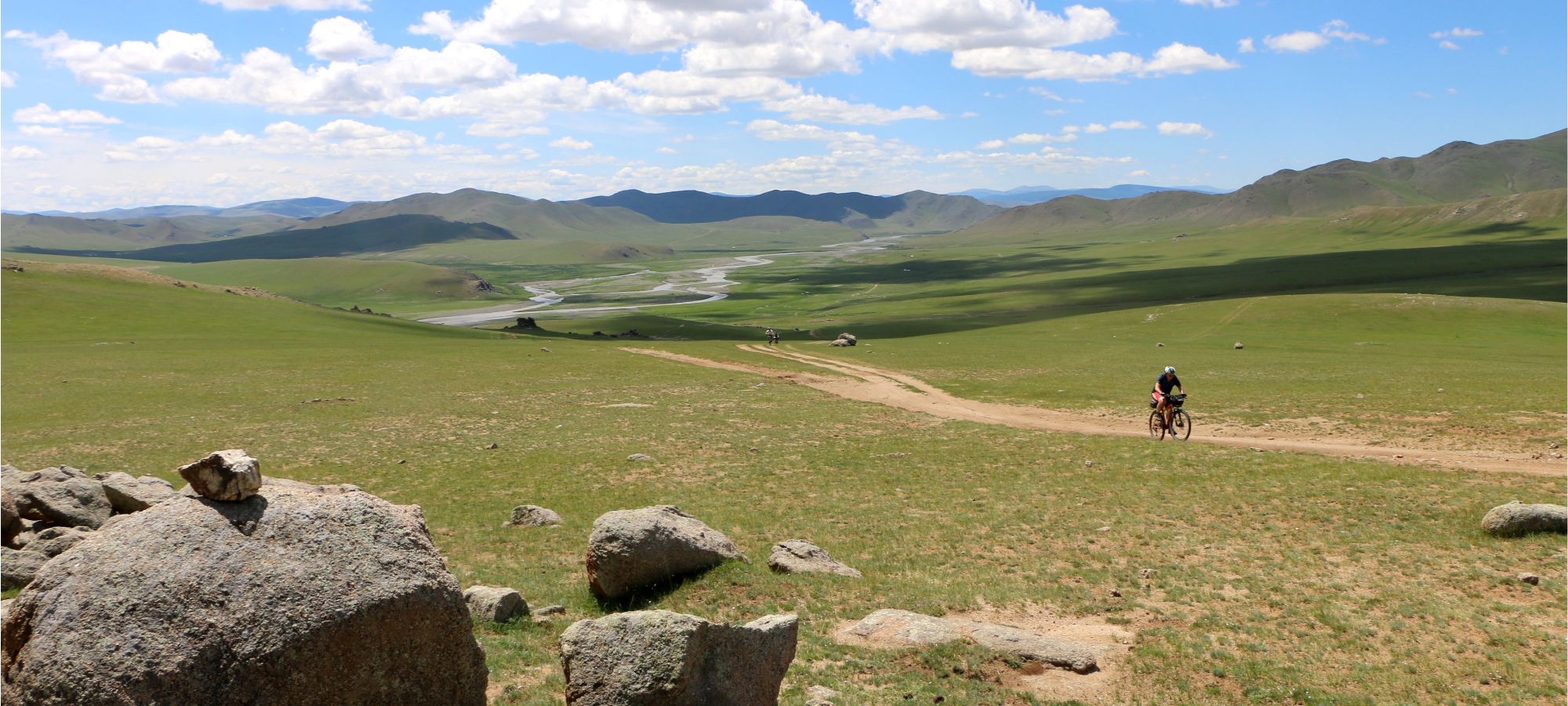
A fast day’s riding on well surfaced road as we ride towards the Orkhon river valley. There area is a UNESCO world heritage site and scattered with volcanic rock and ancient burial mounds. We camp tonight at the riverside and can take a refreshing dip in the water before dinner.
Cycling distance: 76km (47 miles)
Total Climb: 1,070m (3,510 ft)
Total Descent: 1,161m (3,809 ft)
Accommodation: Camping (B,L,D)
Today’s ride is a gradual descent with a few undulations as we cycle downhill following the river downstream to reach Karakorum, the ancient 13th century Mongol Empire Capital, a city built by nomads constructed under the direction of the second son of Genghis Khan. We then cycle on to our ger camp to leave the bikes and take a quick shower before setting off to explore the sights of Karakorum. The ancient city was destroyed in the late 14th C by invading Chinese armies. There is a monastery museum Erdene Zuu established in 16th century by a Mongol khan as part of introduction of Buddhism as the main religion. The monastery was almost completely destroyed during the anti-religion campaign in the 1930s. Just a dozen temples survive. We visit the monastery and museum to see the few surviving artefacts of the old capital. This evening we will mark the end of our cycling adventure with a celebratory meal.
Cycling distance: 72km (45 miles)
Total Climb: 512m (1,679 ft)
Total Descent: 722m (2,532 ft)
Accommodation: Ger Camp (B,L,D)
This morning we will drive back to Ulaanbaatar stopping for a picnic lunch at scenic spot along the way. Be sure to keep a look out for eagles circling above. The route takes you past roadside shrines called ‘ovoos’. The stone shrines are erected by local families and travellers to show gratitude and respect, and to honour the spirits of the surrounding land. It is customary that Ovoos are circled three times in a clockwise direction and a small offering is made in order to ensure the safety of a trip or to ensure good fortune in life. After you have checked into your hotel we will congregate for farewell meal.
Accommodation: Hotel (B,L,D)
Today the redspokes’ Gobi Desert to the Khangai Mountains cycling tour ends. You will be transferred to the airport for your flight home.

The Essential Information for this tour is currently unavailable.
See our Accommodation Grading page for more details.