

Welcome to redspokes ethical cycling holidays. Redspokes specialise in guided mountain bike trips packed with adventure, for small groups of cyclists to the more remote and spectacular regions in the world. At redspokes we try to put something back into the poverty stricken areas that we cycle to. We believe in ‘ethical cycling’. You can view the different charity projects we have been involved in below.
Ethical Tourism:
Redspokes is committed to running tours that respect the communities and localities in the areas they cycle through. Our aims and intentions include:
- Respect for the natural environment,
- Respect for local cultures their lifestyles, routines, religious and historic culture,
- A commitment to benefit our host communities economically and through social engagement,
- A commitment to conserve natural resources wherever possible,
- A commitment to minimise pollution in the provision of our support services, through noise and waste disposal.
We live in a world where:
- Half the population lives on less than $2 a day,
- 67% of the wealth is owned by just 2% of the population,
- The US spends $400 billion a year on weapons,
- It would take $324 billion to end extreme poverty worldwide.
At Redspokes we try to “put something back” You can view the different projects we have been involved in by clicking the items below…
Laos & Thailand
Ban Faen village is home to our guide Khen Phetxayphone, most of the villagers are farmers who work in the surrounding rice fields, it has no running water or electricity, a generator provides 2 hours electricity a night. When redspokes started to work with Khen in 2001, we talked to the Headman and Elders to determine what support the village needed and where our support would have the greatest effect. After some discussion, it was agreed that the 2 main issues facing the village was access to clean drinking water and the school. We decided to start by helping the school. This decision was not unanimous, as there were mixed opinions about the value of education, particularly for girls. Nonetheless, our first donation went towards concreting the school’s floor.
In 2003 redspokes and supporters started a charity LVCF. Shortly after we ran our first project building a school in Ban Faen. This school is now complete, we have went on to build a second (basic) school in one of the rural hmong villagas we visit.
The LVCT decided in 2006 to look at issue of clean water and the issue of land mines, a major issue in this poor country.
Water project
The Elders highlighted the lack of fresh water supply to the village in our discussions. Currently, fetching water from the nearest river for cooking and drinking is an arduous task, requiring a walk of over one kilometre. The task is made twice as difficult during the rainy season, when the ground is muddy, the river is high, and the water is dirty. Our new project is therefore to fund a project that will bring fresh water into the village. The scale of this project has require significant levels of financial support from supporters of redspokes and the LVCT. We would like to thank everyone who has made this happen, particularly to Conor, Steve and Shane who have been the commitee members of the charity.
Khen has expressed his thanks on behalf of his village to all those who have contributed:
“I on behalf of the people in Ban Faen village, would like to give a thousand thanks to redspokes and to all people who have travelled with you for all the help you have given to our community.”
Cluster bombs / Cope
90,000,000 cluster bombs were droped in Laos/Thailand in a nine year period. It has been estamated that 30% of these bombs didn`t explode. Since the war (secrete) finished in 1975.
Contact was made with Cope (the Cooperative Orthotic and Prosthetic Enterprise) the organisation that provides all of the prosthetic and orthotic devices to all Lao people with a mobility disability. This includes many people who have been disabled as a result of UXO explosions.
Dear redspokes!
“On behalf of the staff here at the rehabilitation centre and all the patients that your donations have helped I would like to say…
THANK YOU!!!
Over the past 2 years redspokes and its tour groups have been extremely generous to the project. This year, without support from you we would not be still going. The donation that Andy Hearn sent was at a critical time. The need for help is overwhelming at times but it means so much that a bunch of strangers arrive every few months on your tours and leave as supporters of COPE.
Your passion for the country is tangible and seemingly infectious! So please keep coming to visit! A small amount of money can do so much here. A two thousand dollar donation can provide 40 lower limb prosthetics, 80 club foot treatments or feed a patient in our centre for 1666 days! It is this ‘cash’ which is hard for us to raise and is why we rely so much on support from people such as yourselves! Many many thanks for your continued support and we look forward to welcoming you here again soon. Our visitor centre should be open in some form by the time you are scheduled to come through. With warmest wishes from Laos/Thailand.”
Jo Pereira, COPE
Tibet
Braille Without Borders
In the summer of 1997 Sabriye Tenberken, blind herself, travelled to Tibet to investigate the possibility of providing training for Tibetan blind and visually impaired people. Sabriye realised there were no programs educating and rehabilitating blind people within the country.
She then took the initiative to found the present project. Along with her partner Paul Kronenberg they established a school for the blind and helped altered the traditional attitude towards blind people, who for centuries have been viewed as cursed and treated as lepers or worse.
Over the past 2 years BWB have had contributions from redspokes and our groups who have visited the project in Lhasa.
Dear redspokes,
In the name of our students and staff we want to say THANK YOU VERY MUCH for all the support you and your groups have given us over the past few years!
“We have used the donations for new shoes. These are needed about twice a year… (We do buy the best quality but unfortunately these don’t make it too long in Tibet!) We appreciate your support very much and for us to be able to give more blind students a chance to receive education funds stay very necessary and are therefore very welcome”
All students, staff, Jyila. Sabriye and Paul 03/06/07
“We will use the money for running costs. To give you an idea, last year we had 50 students, 11 people staff in the Lhasa projects: Braille book printing house, preparatory school, medical massage training and the self-integration project. The monthly running costs which include salaries for all staff members, food, school materials and all other operational costs were 2,369.80 Euro (£1,610). Hope this gives an idea what can be done with small sums of money. Please find attached a thank you note for the travellers”
Paul and Sabriye 30/10/06
Per WHO statistics, 161 million persons live with a disabling visual impairment, of whom 37 million are blind and 124 million are persons with low vision. About 90% of them live in developing countries. 9 out of 10 blind children in these countries have no access to education. It is the lack of education and understanding of the sighted society that blind children don’t have equal chances in comparison to their sighted peers. Only if blind people themselves speak out, can attitudes to blindness change.
More details about Braille Without Borders and their work can be found at www.braillewithoutborders.org.
If you would like to contribute to this worthwhile charity please contact Paul Kronenberg at paul.kronenberg@gmail.com.
Peru
Vizcachani School
This is redspokes guide Edwardo Molina description of the school we are supporting in Peru.
Vizcachani is a little place in the middle of the National reserve of salinas y Aguada Blanca on the way to the Colca Canyon, it is at 4.400 metres high. In the place there are just 2 houses, a church and a school, where everyday 13 kids arrive to go the primary school, they are shepherds children between 4 to 12 years old. They have only one teacher for all the different levels, he teaches them in small groups in just one class room.
Most of the children live far away from the school. Some of them walk 3 hours to get there, climbing hills and crossing streams in the middle of nowhere to arrive often without a proper breakfast, just a cup of chachacoma tea (herb of the andes) and some barley flour called mashka. This has to last until they return home in the late afternoon. They walk with ruber sandals and shaby clothes, not suitable for that cold weather in the high Andeas.
Eduardo Molina redspokes.
Over the past few years we have started making small contributions to the school, these have included boxes of food and warm clothes for the children.
Ban Land Mines
We have work for a number of years in Laos/Thailand and seen the consequences of that war on the civilian population. Thirty years after America dropped their last bomb, farmers in their fields and children unfortunate enough to find a ‘plaything’ continue to lose limbs and get killed.
There were 90,000,000 (yes, ninty million) cluster bombs dropped. Other than the obvious danger at the time of impact, up to a quarter of the bomblets fail to explode, creating a minefield for civilians long after the war finished. Young children are especially vulnerable because they are attracted to the shape and colour of the bomblets.
Red Spokes has affiliated to the Stop the War Coalition and urges all our customers to do the same. The aim of the Coalition is very simple: to stop the war currently being fought by the United States and its allies against ‘terrorism’. We condemn the attacks on New York and we feel the greatest compassion for those who lost their life on 11th September 2001. But this war will simply add to the numbers of innocent dead, (estimated at over 800,000) cause untold suffering, political and economic instability on a global scale.
Burma
Why do we use Burma not Myanmar? The military regime changed the name of the country to “Myanmar” on 26th May 1989. The democracy movement and the leaders of the ethnic resistance organisations, however continue to use “Burma” and have urged the international community to do the same. They argue that the regime had no mandate to change the name of the country.
A country of around 50 million people is ruled by fear. A military machine of 500,000 soldiers denies a whole nation its most basic rights. It`s military regime has since 1996 sought to attract international tourists to what is indeed one of the world’s most diverse and beautiful lands. Yet large parts of Burma remain off-limits to tourists because of military operations, narcotics trafficking in border areas, and a contentious gas pipeline built across southern Burma. And many tourism-related projects have involved massive forced labour, arbitrary property seizures, compulsory relocations, and other human rights abuses.
Aung San Suu Kyi pro-democracy leader and Nobel Peace Prize winner, who spent more than 15 years under house arrest in Rangoon, symbolises the struggle of Burma’s people to be free. Her Party, the National League for Democracy (NLD) won 82% of the seats in elections held in 1990. The people of Burma overwhelmingly rejected military rule yet the military continues to refuse to transfer real power to Burma’s democratically elected leaders.
In the past the NLD argued that travel to Burma was an endorsement of the military regime as money from tourism went to the government. There€™s evidence that some tourism complexes were built with forced labour, and that villages were cleared to make way for luxury hotels. Aung San Su Kyi has now indicated that responsible travel can help to change Burma. Burma Campaign UK (who redspokes have been long time supporters of) has also revised its position on travel to Burma.
Climate Care
Red Spokes has also linked up with Climate Care, an organisation that helps you to repair the damage your activities do to the climate. It does this by ‘offsetting’ the greenhouse gas emissions, such as CO2, from your activities by reducing an equivalent amount of CO2 on your behalf.
These reductions are made through a range of projects in renewable energy, energy efficiency and rainforest restoration which not only fight climate change but bring benefits to communities round the world.To find out more visit www.climatecare.org Red Spokes will make a donation to Climate Care for every guide who leads tours abroad.
See below some of the different projects Climate Care’s have been involved in…
Efficient stoves in Honduras
Climate Care is working in Honduras to make fuel efficient cooking stoves available in some of the poorest communities. This supports conservation by reducing the wood needed for cooking. It also benefits the householders by removing smoke from the kitchen and dramatically cutting the health risk from wood smoke. Each stove reduces carbon dioxide emissions by around 1.5 tonnes per year, compared to an open wood fire.
The project is expected to save 7,000 tonnes of CO2.
Renewable power for schools in India
Climate Care is funding a project to introduce school stoves that run off a new renewable fuel source, replacing stoves that use fossil fuel LPG. Crop waste is being used to make biomass briquettes for the stoves, providing an extra income to farmers. For the schools this is good news because the new renewable fuel is cheaper. The stove has also proved popular with pupils, who prefer the taste of the food!
This project is expected to save 11,000 tonnes of CO2 emissions.
Human powered water pumps in India
Climate Care™s funding is helping to expand the availability of a simple and ingenious ‘treadle pump’, which can be used by farmers to irrigate their crops, replacing dirty and expensive diesel pumps. Crops can be grown all year round, helping farmers to increase their yields and stay on their land all year round without having to leave to find work in the cities.
Each treadle pump saves around 0.65 tonnes CO2 per year.
Laos
Ban Faen Village
Ban Faen village is home to our guide Khen Phetxayphone, most of the villagers are farmers who work in the surrounding rice fields, it has no running water or electricity, a generator provides 2 hours electricity a night. When redspokes started to work with Khen in 2001, we talked to the Headman and Elders to determine what support the village needed and where our support would have the greatest effect. After some discussion, it was agreed that the 2 main issues facing the village was access to clean drinking water and the school. We decided to start by helping the school. This decision was not unanimous, as there were mixed opinions about the value of education, particularly for girls. Nonetheless, our first donation went towards concreting the school floor.
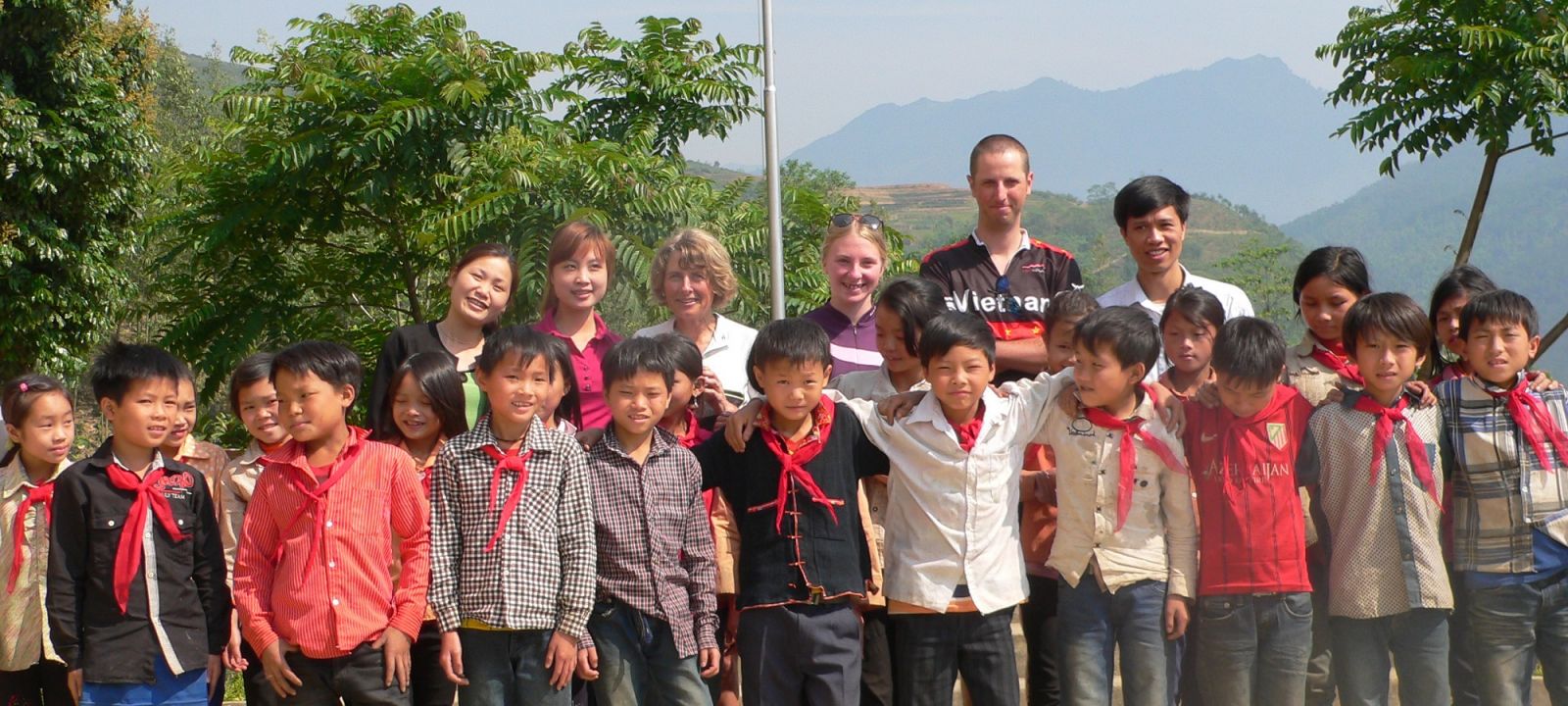
In 2003 redspokes and supporters started a charity LVCF. Shortly after we ran our first project building a school in Ban Faen. This school is now complete, (see photo at top of page) we have went on to build a second (basic) school in one of the rural hmong villagas we visit.
The LVCT decided in 2006 to look at issue of clean water and the issue of land mines, a major issue in this poor country.
Water project
The Elders highlighted the lack of fresh water supply to the village in our discussions. Currently, fetching water from the nearest river for cooking and drinking is an arduous task, requiring a walk of over one kilometre. The task is made twice as difficult during the rainy season, when the ground is muddy, the river is high, and the water is dirty. Our new project is therefore to fund a project that will bring fresh water into the village. The scale of this project has require significant levels of financial support from supporters of redspokes and the LVCT. We would like to thank everyone who has made this happen, particularly to Conor, Steve and Shane who have been the commitee members of the charity.
Khen has expressed his thanks on behalf of his village to all those who have contributed:
“I on behalf of the people in Ban Faen village, would like to give a thousand thanks to redspokes and to all people who have travelled with you for all the help you have given to our community.”
Cluster bombs / Cope
90,000,000 cluster bombs were droped in Laos/Thailand in a nine year period. It has been estamated that 30% of these bombs didn`t explode. Since the war (secrete) finished in 1975.
Contact was made with Cope (the Cooperative Orthotic and Prosthetic Enterprise) the organisation that provides all of the prosthetic and orthotic devices to all Lao people with a mobility disability. This includes many people who have been disabled as a result of UXO explosions.
Dear redspokes!
“On behalf of the staff here at the rehabilitation centre and all the patients that your donations have helped I would like to say…
THANK YOU!!!
Over the past 2 years redspokes and its tour groups have been extremely generous to the project. This year, without support from you we would not be still going. The donation that Andy Hearn sent was at a critical time. The need for help is overwhelming at times but it means so much that a bunch of strangers arrive every few months on your tours and leave as supporters of COPE.
Your passion for the country is tangible and seemingly infectious! So please keep coming to visit! A small amount of money can do so much here. A two thousand dollar donation can provide 40 lower limb prosthetics, 80 club foot treatments or feed a patient in our centre for 1666 days! It is this ‘cash’ which is hard for us to raise and is why we rely so much on support from people such as yourselves! Many many thanks for your continued support and we look forward to welcoming you here again soon. Our visitor centre should be open in some form by the time you are scheduled to come through. With warmest wishes from Laos/Thailand.”
Jo Pereira, COPE
School in Bagrot
August 2014 BAGROT SCHOOL HEADTEACHER VISIT TO THE UK
Redspokes is very happy to welcome Mr Hashim Ali to the UK for a 6 month study programme. Mr Hashim is Head Teacher of The BASE (Bagrot Association for Social Enhancement) School in the Bagrot Valley, Gilgit/Baltistan. The School was set up in 2002 by the local community with the aim of helping more children from the valley access higher education. English is regarded as the key to this.
Hashim Ali is one of the best English-speaking teachers in the valley, he will study in the UK to improve his English so that he can return and further train his teachers. Although they are all graduates and speak English to some degree, there is no way for them to hear English spoken by natives in this remote valley. As part of his training here he will focus on raising the standard of pronunciation, inflection and knowledge of idioms. Mr Hashim will promote an English-speaking programme on his return in other areas of the Bagrot Valley and with the Education Department in Gilgit.
During his stay here Mr Hashim will stay with Tim and Ruth Dunsby, both retired teachers who volunteered at the BASE in 2013 which was arranged through redspokes and the LVCF. They have been instrumental in supporting his visit to the UK. Please come and meet Mr Hashim and learn more about his school on 27 September.
Venue: Z bar, 58 Stoke Newington High Street, London, N16 7PB
On the 2nd March 2013 we will be holding a fundraising event in aid of our newest charity appeal http://www.justgiving.com/LVCF-Redspokes-Bagrot-appeal and would love it if you could join us for the evening in London. We have a fantastic line up for the night which will focus on the area; the work we have been doing; and the latest campaign.
The evening will kick-off with a screening of the award-winning film €˜Karakoram Highway: Road to Globalisation which focuses on the area we’ve been working in. We’re delighted to have one of the film’s directors, Gabriela Neuhaus, joining us from Zurich for the evening too.
Our guest speaker is Monika Schneid, a great friend of the charity and truly inspirational person. Monika first visited Bagrot in 1990 and went on to open a highly respected girls school in the valley, which she still oversees today. She has learnt to speak Shina fluently and sits on the board of the community self-help organisation that runs the school in Bagrote. Monika will talk about her experiences setting up the school and living in this beautiful, remote part of the world.
So the evening will go something like this:
6:30pm: Doors open / welcome
7:00pm: Film screening: Karakoram Highway: Road to Globalisation with an introduction from the director, Gabriela Neuhaus.
8:00pm: Food: hot and cold mezes
8.30pm: Guest speaker: Monika Schneid‚ On her experience of living in a remote Shia community in Northern Pakistan, followed by questions.
9:45pm: Brief (promise) sum up talk from Dermot
Venue: Zbar, 58 Stoke Newington High Street, London, N16 7PB
I really hope you’ll be able to join us for the evening‚ it should be an informative & fun night. The cost, which includes food, is £20, with all profits going straight into the appeal.
Please note that space is limited the first 50 people: RSVP essential by email.
PAKISTAN FLOODINGA little over a year ago we asked for your help with an urgent appeal for the people of Hussainabad in northern Pakistan. We hoped to raise £4,000 to provide warm clothing, fuel and shelter for 50 families who had lost their homes due to a landslide during the 2010 flooding. The families had been re-housed in tents in a local IDP camp, but with the NGO’s already stretched elsewhere in the country, there were no plans for assistance beyond this.
The response to our appeal was amazing. You donated £4,120 (over £5,200 with Gift Aid) in less than 2 months, at a time when all talk here was of economic gloom and belt tightening. The situation in Pakistan was moving quickly, and it became clear that the Aga Khan Foundation (the only major NGO working in the region) was also earmarking funds for the village. As a result, we were able to think beyond temporary shelter and look towards permanent re-housing for the families.
Working with the Aga Khan Foundation, whose buildings agency (the AKPBS) provided the technical know-how and raw materials, your donations paid for up to 30 labourers each day to work on the rebuilding project. This involved building 28 brand new homes to replace those that were either beyond repair or were located on ground deemed to be at risk of further landslide. The village committee, set up by our friend Mr Arman, oversaw recruitment of good people and payment of their wages. As a result, all the houses were complete by Spring last year and all 50 families were either back in their repaired homes, or re-settled in the brand new ones result!
Following this we were still left with a substantial chunk of the appeal fund (labour in northern Pakistan is so cheap!). Since then we have been actively looking at how best to spend this money, in a way that does justice to the generosity everyone showed. At the forefront of our minds has been to find a small, sustainable project, that can be administered transparently and bring genuine benefits to the community.
We had several disappointing dead ends, but now believe we may have found a really great project to support. We found this through contact with an amazing German woman, Monika Schneid, who’s lived in the Bagrot valley (to the east of Gilgit) for many years, running a girls school she set up there. As she’s mastered the local Shina language she’s very well connected in the area and was able to put us in contact with two community leaders in the village of Chirah.
Chirah is the final village along the valley road and the least well developed. It has a small primary school and the older children attend secondary in the next village along and we contacted them with the suggestion of supporting the schools. The villagers felt that the current arrangement is acceptable for the time being but saw another priority. We therefore hope to set up a small women’s centre in the village, equipped with sewing machines and a qualified sewing teacher. This would give the women a skill with which to earn an income, selling the textiles locally at market. Gilgit-Baltistan is an area where few women work, and many men still leave the home to look for work elsewhere, so we hope this will be a really worthwhile initiative. It’s one that the village are all really behind.
Sorry that this update has been so long in coming, but thank you again, and we’ll keep you posted!
A sincere thank you from:
- Mr Arman Ali, Red Spokes guide and village resident
- The Hussainabad Disaster Management Committee
- Mr Nasir Hussain
- LVCF*
- And all at Red Spokes Adventure Tours
* LVCF is a registered UK charity originally set up in 2004 by a group of cyclists inspired by a tour of Laos with Red Spokes Adventure Tours. Its original aim was to provide direct funding to rural villages in Laos for education and water projects. The scope of the charity has now been extended to include other countries where there are clear needs which the charity can address.
KKH Community Support
Karakoram Highway Appeal
LVCF, a charity set up by Redspokes Adventure Tour cyclists, initially provided funding for emergency housing in Hussainabad following the disastrous floods in 2010; more recently it has has set up a women’s sewing centre in Chirah to give women a skill with which to earn an income, selling the textiles locally at market. Buoyed on by the success of these projects and the great appreciation and enthusiasm of the locals (and of the Redspokes tour participants), we are now raising funds to provide further funding for the instructor at the Sewing Centre, grants to help the women buy sewing machines after being trained, funding for a teacher to teach English, and other sustainable projects in the area. As with all our campaigns, this will be done at minimal cost and without payments to intermediaries.
Red Spokes has been working in Northern Pakistan since 2003, and our guide, Mr Arman, alerted us to the situation in his own village, Hussainabad, following the disastrous floods in 2010. There, approximately 400 people (50 families) were living in tents after landslides destroyed surrounding crop fields and left their homes too dangerous to live in. With funding from this campaign we helped to provide substantial shelters for these people.
Following the success of this project, we realised that this remote part of the country receives little outside help, and began to appreciate how a small amount of funding can start to regenerate a community – particularly where the locals participate actively. We made good local contacts with trusted people, and decided that the best way we could help was to provide local women with a skill that would help them to earn money so they could sustain their families – hence the Women’s Sewing Centre. This was set up earlier this year using a building that was provided for free by a local resident. LVCF provided the equipment (sewing machines etc) and the initial funding for the instructor, who is working for half her previous pay in order to help the community.
A recent Redspokes tour in June 2012 visited the village and was overwhelmed by the warmth of feeling and the genuine gratitude of the local villagers, and we thus enter the third phase of this campaign – initially to provide funding for an English teacher and further funding for the instructor, then grants to help the women buy sewing machines after being trained, and also for further sustainable projects in the area.

Need some help?
Still not sure which tour is right for you? Tell us how often you ride, the kind of terrain you enjoy, and your ideal holiday length and we’ll suggest a shortlist of tours that fit you.